

The success of an Agentic AI solution should be measured across multiple dimensions — not just model accuracy. Since Agentic AI systems are autonomous, goal-driven, and capable of decision-making and orchestration, the metrics should evaluate:
- Business impact
- Agent performance
- Operational efficiency
- Reliability & safety
- User experience
- Learning & adaptability
Below is a structured framework of metrics commonly used for evaluating Agentic AI solutions.
Metrics to Measure the Outcome of an Agentic AI Solution
1. Business Outcome Metrics
These measure whether the AI agent is delivering actual business value.
| Metric | Description | Example |
|---|---|---|
| ROI (Return on Investment) | Financial gains vs implementation cost | 25% reduction in operational cost |
| Revenue Impact | Increase in sales or conversions | AI sales agent improved lead conversion by 18% |
| Cost Reduction | Reduction in manual effort or infrastructure | Reduced support staffing effort |
| Productivity Improvement | Faster task execution | Claims processing time reduced from 3 days to 3 hours |
| SLA Adherence | Meeting agreed service timelines | 98% ticket resolution within SLA |
| Process Automation Rate | % of tasks fully automated | 70% HR queries automated |
2. Agent Performance Metrics
These evaluate how effectively the AI agent performs assigned tasks.
| Metric | Description |
|---|---|
| Task Success Rate | Percentage of successfully completed tasks |
| Goal Completion Accuracy | Whether the agent achieved intended outcomes |
| Decision Accuracy | Quality of decisions taken autonomously |
| Multi-Step Completion Rate | Ability to execute end-to-end workflows |
| Tool Utilization Accuracy | Correct usage of APIs/tools/systems |
| Reasoning Effectiveness | Logical consistency of decisions |
| Error Recovery Rate | Ability to recover from failures autonomously |
Example
An IT support agent:
- Receives incident
- Diagnoses issue
- Creates ticket
- Resolves automatically
Success is measured by:
- Correct diagnosis %
- Resolution %
- Escalation %
- Rework required
3. Operational Efficiency Metrics
These measure how efficiently the AI operates.
| Metric | Description |
|---|---|
| Response Time | Time taken to respond |
| Task Completion Time | Total end-to-end execution time |
| Throughput | Number of tasks processed |
| Resource Consumption | CPU/GPU/API usage |
| Token Usage Efficiency | LLM token optimization |
| Scalability | Performance under increasing workload |
| Concurrent Agent Handling | Ability to manage multiple workflows |
4. User Experience Metrics
Critical for customer-facing or employee-facing agents.
| Metric | Description |
|---|---|
| User Satisfaction Score (CSAT) | User feedback ratings |
| Net Promoter Score (NPS) | Willingness to recommend |
| User Adoption Rate | Frequency of usage |
| Retention Rate | Continued engagement |
| Conversation Quality | Naturalness and usefulness |
| Escalation Rate | Frequency of human intervention |
| Trust Score | User confidence in AI decisions |
5. AI Quality Metrics
These focus on model and reasoning quality.
| Metric | Description |
|---|---|
| Hallucination Rate | Frequency of incorrect/generated facts |
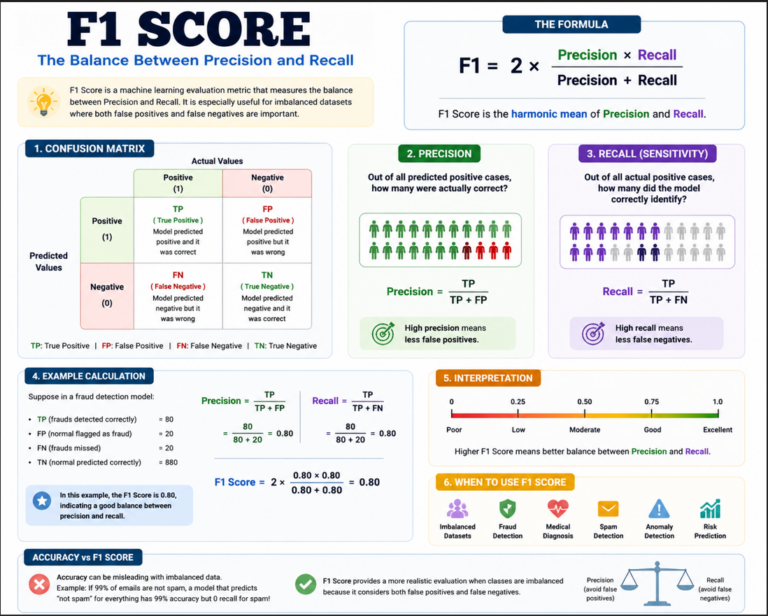
| Precision | Correct positive predictions |
| Recall | Coverage of relevant outcomes |
| F1 Score | Balance between precision and recall |
| Context Retention | Ability to remember workflow context |
| Intent Recognition Accuracy | Understanding user intent |
| Plan Execution Accuracy | Quality of generated execution plans |
6. Reliability & Stability Metrics
Agentic AI systems must be dependable.
| Metric | Description |
|---|---|
| System Uptime | Availability percentage |
| Failure Rate | Frequency of failures |
| Retry Success Rate | Recovery after failure |
| Incident Frequency | Number of operational incidents |
| Mean Time to Recovery (MTTR) | Recovery speed |
| Workflow Completion Reliability | Stability of orchestration |
7. Security & Responsible AI Metrics
Especially important in healthcare, banking, and enterprise AI.
| Metric | Description |
|---|---|
| Data Leakage Incidents | Unauthorized exposure |
| Compliance Adherence | GDPR/HIPAA/ISO compliance |
| Bias Detection Score | Fairness of outputs |
| Toxicity Rate | Harmful responses generated |
| Human Override Frequency | Need for manual corrections |
| Auditability | Ability to trace decisions |
| Access Control Violations | Unauthorized access attempts |
8. Learning & Adaptability Metrics
Unique to Agentic AI because agents continuously adapt.
| Metric | Description |
|---|---|
| Learning Improvement Rate | Performance improvement over time |
| Feedback Incorporation Speed | How quickly feedback improves outcomes |
| Adaptation Success | Ability to handle new scenarios |
| Memory Utilization Effectiveness | Use of historical context |
| Autonomous Optimization Rate | Self-improvement frequency |
Technical Metrics for Multi-Agent Systems
For systems with multiple collaborating agents:
| Metric | Description |
|---|---|
| Agent Coordination Efficiency | Communication effectiveness |
| Inter-Agent Conflict Rate | Contradictory decisions |
| Collaboration Success Rate | Successful orchestration |
| Workflow Dependency Resolution | Managing task dependencies |
| Orchestration Accuracy | Correct sequencing of tasks |
Example: Metrics for an AI Customer Support Agent
| Category | Metrics |
|---|---|
| Business | Cost savings, ticket reduction |
| Performance | First-call resolution rate |
| UX | CSAT, response quality |
| Efficiency | Average response time |
| AI Quality | Hallucination rate |
| Reliability | Uptime |
| Security | PII leakage incidents |
Balanced Scorecard Approach for Agentic AI
A mature AI program typically tracks metrics in 4 layers:
A. Strategic Metrics
- ROI
- Business growth
- Customer satisfaction
B. Operational Metrics
- Automation rate
- Throughput
- SLA adherence
C. AI Metrics
- Accuracy
- Hallucination
- Reasoning quality
D. Governance Metrics
- Compliance
- Bias
- Security
- Auditability
Important Consideration
Unlike traditional ML models, Agentic AI systems are:
- Autonomous
- Goal-driven
- Adaptive
- Multi-step
- Tool-using
Therefore, success measurement should not rely only on model accuracy.
It must evaluate:
- Decision quality
- Workflow orchestration
- Safety
- Reliability
- Human trust
- Business value
Executive Summary
“The success of an Agentic AI solution should be measured using a multi-dimensional framework covering business impact, agent performance, operational efficiency, AI quality, reliability, user trust, and governance. Since Agentic AI systems operate autonomously and perform multi-step reasoning, metrics should evaluate not only prediction accuracy but also workflow completion, decision quality, adaptability, compliance, and overall business outcomes.”