
Table of Contents
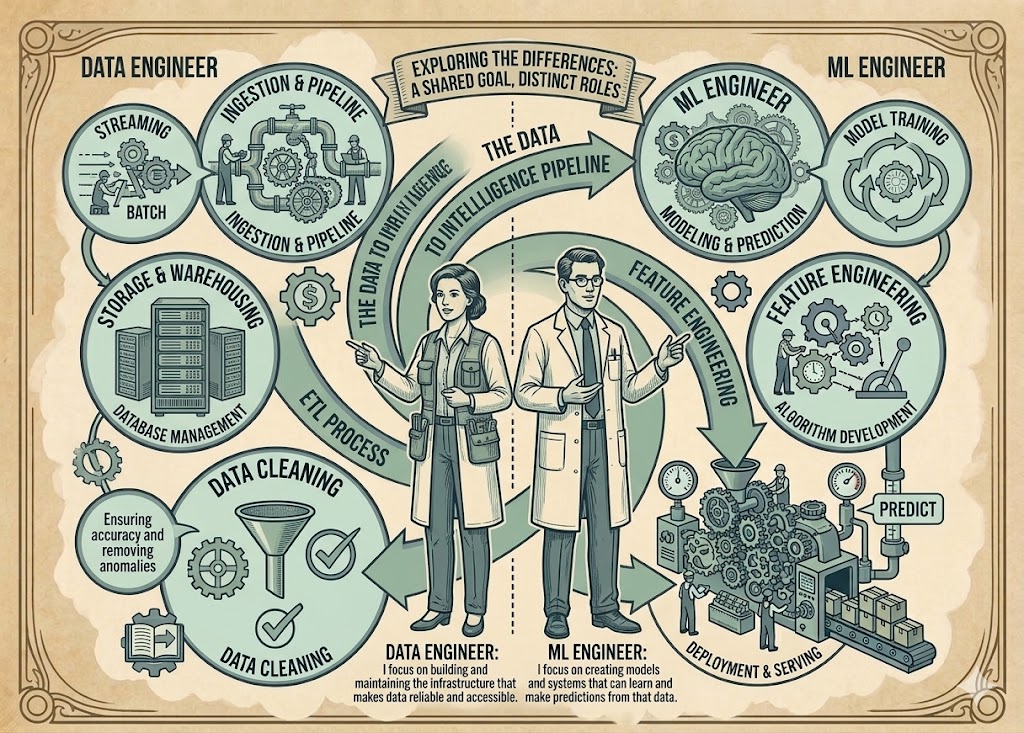
A Data Engineer and a Machine Learning (ML) Engineer both work with data, but their focus, responsibilities, and outcomes are quite different.
Here’s a practical comparison:
| Area | Data Engineer | ML Engineer |
|---|---|---|
| Primary Focus | Building and managing data pipelines | Building and deploying ML/AI models |
| Main Goal | Ensure clean, reliable, scalable data availability | Create intelligent systems that learn from data |
| Works On | ETL/ELT pipelines, data lakes, warehouses | Training models, inference APIs, model optimization |
| Typical Technologies | SQL, Spark, Hadoop, Kafka, Airflow, Snowflake | Python, TensorFlow, PyTorch, Scikit-learn, MLflow |
| Output | Structured, accessible data systems | Prediction/recommendation/classification models |
| Key Skill | Data architecture and processing | Algorithms and model engineering |
| Performance Measured By | Data quality, pipeline reliability, scalability | Model accuracy, latency, drift, business value |
| Infrastructure Role | Creates foundation for analytics and AI | Uses that foundation to build AI solutions |
| Interaction With AI | Supports AI teams with data readiness | Directly develops AI/ML capabilities |
Simple Analogy
Think of an AI-powered food delivery app:
- A Data Engineer builds the highways and supply chain:
- Collects restaurant data
- Cleans customer/order data
- Creates real-time pipelines
- Stores data in warehouses
- An ML Engineer builds the intelligence:
- Predicts delivery times
- Recommends food
- Detects fraud
- Optimizes routing
Typical Responsibilities
Data Engineer
A Data Engineer usually:
- Designs data architecture
- Builds ETL/ELT pipelines
- Handles batch and streaming data
- Integrates multiple systems
- Ensures data governance and security
- Optimizes database/query performance
Common tools:
- Apache Spark
- Apache Airflow
- Snowflake
- Apache Kafka
ML Engineer
An ML Engineer usually:
- Prepares ML datasets
- Trains and fine-tunes models
- Deploys models to production
- Builds inference APIs
- Monitors model drift and performance
- Automates retraining pipelines (MLOps)
Common tools:
- TensorFlow
- PyTorch
- MLflow
- Scikit-learn
Skill Comparison
Data Engineer Skills
- SQL mastery
- Distributed systems
- Data modeling
- Cloud data platforms
- Pipeline orchestration
- Data governance
ML Engineer Skills
- Statistics & probability
- Machine learning algorithms
- Python programming
- Model deployment
- Feature engineering
- MLOps & monitoring
In Modern AI Programs
Since you are exploring AI program management and enterprise AI transformation, this distinction becomes important:
- Data Engineers enable AI readiness.
- ML Engineers enable AI intelligence.
A mature AI program generally needs both.
For example in an enterprise GenAI platform:
- Data Engineers create secure vectorized knowledge pipelines.
- ML Engineers build RAG systems, fine-tune models, and optimize inference.
- AI Program Managers coordinate architecture, governance, rollout, and business adoption.
Career Perspective
Data Engineering
Best suited if someone enjoys:
- Systems
- Databases
- Scalability
- Data infrastructure
- Backend engineering
ML Engineering
Best suited if someone enjoys:
- AI algorithms
- Predictive systems
- Experimentation
- Model optimization
- Applied AI
Salary & Demand Trend
Currently both are in high demand, but:
- Data Engineering has broader enterprise demand.
- ML Engineering has higher specialization and AI premium.
- Agentic AI and GenAI are increasingly merging both roles through MLOps/DataOps.
A newer hybrid role is emerging:
- AI Platform Engineer
- LLMOps Engineer
- Agentic AI Engineer
These combine:
- data pipelines,
- vector databases,
- orchestration,
- model deployment,
- and AI agents.