


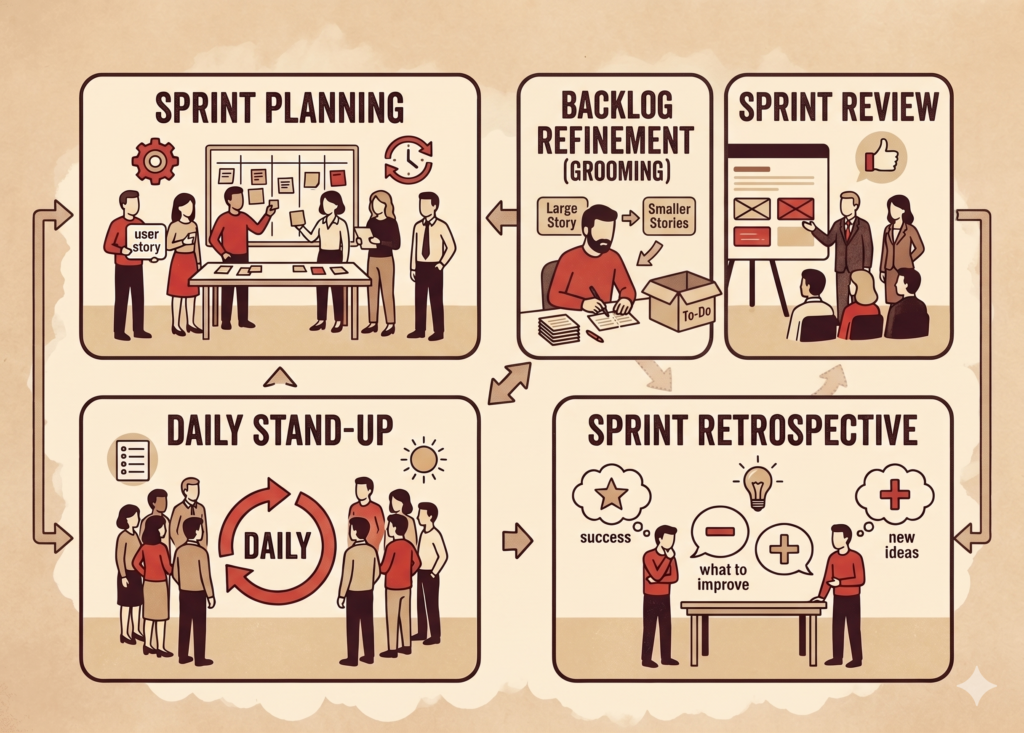
What is a scrum ceremony
A Scrum ceremony is a structured meeting in the Scrum framework that helps Agile teams plan, track, collaborate, and improve their work during a sprint.
In Scrum, there are 5 key ceremonies:
1. Sprint Planning
Purpose: Decide what work will be done in the upcoming sprint.
Participants:
- Product Owner
- Scrum Master
- Development Team
Outcomes:
- Sprint Goal
- Selected backlog items
- Task breakdown
Example:
A team decides which user stories they can complete in the next 2 weeks.
2. Daily Scrum (Daily Stand-up)
Purpose: Synchronize team activities and identify blockers.
Duration:
Usually 15 minutes.
Common Questions:
- What did I complete yesterday?
- What will I work on today?
- Any blockers?
Example:
A developer mentions API dependency delays so the Scrum Master can help remove the obstacle.
3. Sprint Review
Purpose: Demonstrate completed work to stakeholders and gather feedback.
Participants:
- Scrum Team
- Stakeholders
- Business users
Activities:
- Demo completed features
- Discuss progress
- Collect feedback
Example:
The team showcases a new AI chatbot feature to business leaders.
4. Sprint Retrospective
Purpose: Improve team processes and collaboration.
Discussion Areas:
- What went well?
- What did not go well?
- What improvements can be made?
Example:
The team decides to improve code review timelines to reduce deployment delays.
5. Backlog Refinement (Grooming)
(Not officially a Scrum ceremony in the Scrum Guide, but widely practiced.)
Purpose: Prepare future backlog items.
Activities:
- Clarify requirements
- Estimate stories
- Split large tasks
- Prioritize work
Example:
Breaking a large “AI analytics dashboard” story into smaller development tasks.
Simple Scrum Flow
Sprint Planning
      ↓
 Daily Scrum (every day)
      ↓
 Development Work
      ↓
 Sprint Review
      ↓
 Sprint Retrospective
      ↓
 Next Sprint
Why Scrum Ceremonies Matter
They help teams:
- Improve communication
- Increase transparency
- Track progress continuously
- Remove blockers quickly
- Deliver value incrementally
- Continuously improve processes
For someone in AI project/program management like you, Scrum ceremonies become especially useful when managing:
- AI model iterations
- Data engineering dependencies
- API integrations
- Cross-functional teams
- Agile delivery for GenAI/Agentic AI solutions
Would you also like:
- a real-life example of Scrum ceremonies in an AI project, or
- a comparison between Scrum and Kanban ceremonies?
A real life example of a scrum ceremony
Here’s a real-life example of Scrum ceremonies using an AI-powered customer support chatbot project, similar to the kind of AI/technology programs you may manage.
Real-Life Scrum Example
Project:
Developing an AI Customer Support Chatbot for a banking application.
Sprint Duration:
2 weeks
Team:
- Product Owner (Bank Business Lead)
- Scrum Master
- AI/ML Engineers
- Backend Developers
- QA Team
- Data Engineer
- UI Developer
1. Sprint Planning
Objective:
Decide what can be delivered in the next 2 weeks.
Discussion:
The Product Owner prioritizes:
- Intent recognition model
- FAQ integration
- Chat UI enhancements
Team Estimates:
- Intent model training → 5 story points
- API integration → 3 story points
- UI changes → 2 story points
Sprint Goal:
“Enable chatbot to answer top 20 banking FAQs.”
Output:
Sprint backlog created.
2. Daily Scrum (Stand-up)
Example Conversation:
AI Engineer:
“Yesterday I completed model training for account balance queries. Today I’ll test accuracy. Blocker: Need additional banking dataset.”
Backend Developer:
“Completed API integration with CRM system. Today working on authentication.”
QA Engineer:
“Started chatbot response testing. Found latency issues.”
Scrum Master:
“I’ll coordinate with the data team to arrange the dataset.”
Outcome:
- Everyone aligned
- Risks identified early
- Dependencies addressed quickly
3. Sprint Review
At the end of 2 weeks, the team demonstrates the chatbot to stakeholders.
Demo:
- User asks: “How do I reset my debit card PIN?”
- Chatbot answers successfully.
Stakeholder Feedback:
- “Can we add multilingual support?”
- “Responses should include clickable links.”
Result:
New backlog items created for future sprints.
4. Sprint Retrospective
Internal team improvement discussion.
What Went Well:
- API integration completed ahead of time
- Team collaboration was smooth
What Didn’t Go Well:
- AI model training delayed due to poor data quality
- QA received builds too late
Action Items:
- Data validation checklist before sprint start
- Earlier QA involvement
5. Backlog Refinement
Before the next sprint:
Team Activities:
- Break “multilingual chatbot” into smaller stories
- Estimate complexity
- Clarify requirements with business
Example Stories:
- Hindi language support
- Translation API integration
- Multilingual UI toggle
How Scrum Helped in This Real Scenario
| Challenge | Scrum Benefit |
|---|---|
| Changing business requirements | Sprint reviews captured feedback quickly |
| AI model uncertainty | Daily tracking exposed risks early |
| Cross-team coordination | Stand-ups improved communication |
| Continuous improvement | Retrospectives fixed process gaps |
In AI/ML Projects, Scrum Ceremonies Become Very Important Because:
- Data dependencies change frequently
- Model accuracy evolves iteratively
- Business expectations shift often
- Integration teams need constant coordination
- Experiments require transparency
This is why many modern AI programs use Agile + Scrum delivery models.