
Understanding the Three V’s of Big Data in AWS Machine Learning
In today’s data-driven world, organizations generate and process enormous amounts of information every second. Whether it’s social media interactions, IoT sensor streams, customer transactions, or healthcare records, handling data efficiently has become one of the most critical aspects of modern cloud and AI systems.
For professionals preparing for the AWS Certified Machine Learning Engineer – Associate certification, understanding the Three V’s of Big Data is fundamental. These properties — Volume, Velocity, and Variety — influence how data is stored, processed, analyzed, and transformed into actionable insights.
What Are the Three V’s of Data?
The concept of the Three V’s helps data engineers and machine learning professionals understand the challenges associated with large-scale data systems.
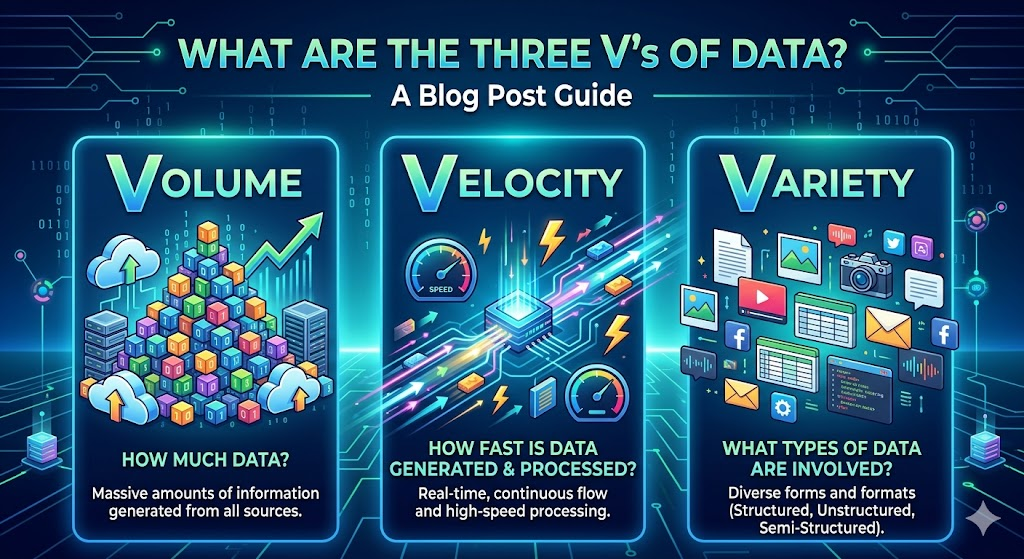
The Three V’s are:
- Volume – How much data?
- Velocity – How fast is the data generated and processed?
- Variety – What types of data are involved?
These characteristics play a major role in selecting the right AWS services and designing scalable architectures.
1. Volume – The Scale of Data
Volume refers to the amount of data being generated, stored, and processed at any given time.
Organizations today deal with data sizes ranging from gigabytes to petabytes and beyond. As data volume grows, traditional single-server systems become insufficient, requiring distributed storage and processing solutions.
Why Volume Matters
Large data volumes impact:
- Storage architecture
- Data ingestion methods
- Processing frameworks
- Query performance
- Cost optimization
For example, moving a few gigabytes of data to AWS can be done over the internet easily. However, migrating petabytes of on-premises data may require solutions like:
- Amazon Web Services AWS Snowball
- AWS Snowmobile
Real-World Examples
Social Media Platforms
Platforms process:
- Billions of posts
- Images
- Videos
- User interactions
This creates terabytes of new data every day.
Retail Industry
Large retailers may accumulate years of transaction history amounting to multiple petabytes of information.
In such scenarios, scalable services become essential:
- Amazon S3 for storage
- Amazon Redshift for analytics
- Amazon EMR for distributed processing
2. Velocity – The Speed of Data
Velocity refers to the speed at which data is generated, collected, and processed.
Some applications generate data continuously and require immediate processing, while others can process data in scheduled batches.
Real-Time vs Batch Processing
One of the key architectural decisions in data engineering is choosing between:
- Batch Processing
- Data processed periodically
- Suitable for reports and historical analysis
- Real-Time Streaming
- Continuous ingestion and processing
- Suitable for fraud detection, live analytics, and monitoring systems
AWS Services for High-Velocity Data
AWS offers several services specifically designed for streaming and real-time analytics:
- Amazon Kinesis Data Streams
- Amazon Data Firehose
- Amazon Managed Service for Apache Flink
- Amazon MSK
Real-World Examples
IoT Sensor Data
Sensors may transmit readings every millisecond, generating continuous streams of information.
High-Frequency Trading Systems
Financial systems require ultra-low latency processing where every millisecond matters.
In such environments:
- Event ordering is critical
- Real-time consistency is required
- Streaming architectures outperform batch systems
3. Variety – Different Types of Data
Variety refers to the different formats, structures, and sources of data.
Modern organizations rarely work with a single type of data.
Types of Data
Structured Data
Highly organized data stored in relational databases.
Examples:
- Customer records
- Financial transactions
- Inventory tables
Semi-Structured Data
Data with flexible schemas.
Examples:
- JSON
- XML
- Log files
Unstructured Data
Data without a predefined format.
Examples:
- Emails
- Videos
- Audio
- Images
- Social media posts
Why Variety Creates Challenges
Different data formats require:
- Different storage mechanisms
- Different processing tools
- Different querying strategies
Organizations often need unified analytics across all these data sources.
AWS Solutions for Data Variety
AWS provides specialized services for handling multiple data types:
- Amazon S3 for unstructured and semi-structured data
- Amazon RDS for structured data
- AWS Glue for data integration
- Amazon Athena for querying data directly in S3
- AWS Lake Formation for centralized governance
How the Three V’s Influence Architecture
The Three V’s directly impact how organizations design their cloud data platforms.
| V | Key Question | AWS Considerations |
|---|---|---|
| Volume | How much data? | Storage scalability, distributed systems |
| Velocity | How fast is data arriving? | Streaming vs batch processing |
| Variety | What type of data? | Multi-format storage and analytics |
Together, these properties shape:
- Data lakes
- Data warehouses
- ETL pipelines
- Machine learning workflows
- Real-time analytics systems
The Growing Importance of Data Engineering
As AI and machine learning continue to evolve, understanding data characteristics becomes increasingly important.
Machine learning systems are only as effective as the data pipelines supporting them. Data engineers and ML engineers must design architectures capable of handling:
- Massive scale
- Continuous ingestion
- Multiple data formats
- Real-time analytics
This is why AWS includes these concepts prominently in its Machine Learning Engineer certification path.
Final Thoughts
The Three V’s — Volume, Velocity, and Variety — provide a foundational framework for understanding big data systems.
Whether you’re building:
- Streaming analytics platforms
- Enterprise data lakes
- AI pipelines
- Real-time dashboards
- Machine learning architectures
…these three principles guide your technical decisions.
As organizations continue generating larger and more diverse datasets, mastering these concepts becomes essential for every cloud, data, and AI professional.