
LangChain
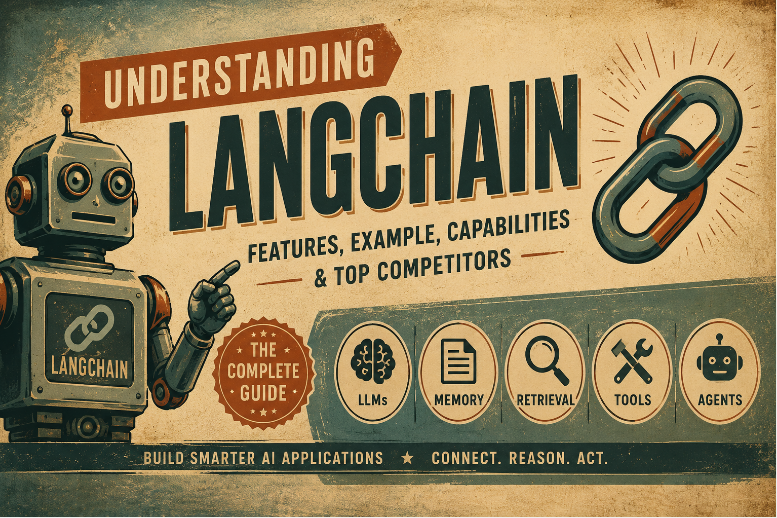
Artificial Intelligence is rapidly moving beyond simple chatbots into intelligent systems that can reason, retrieve information, use tools, automate workflows, and interact with enterprise applications. One of the most popular frameworks enabling this transformation is LangChain.
Whether you are an AI enthusiast, developer, architect, or project manager exploring Generative AI, understanding LangChain is becoming increasingly important in the modern AI ecosystem.
What is LangChain?
LangChain is an open-source framework designed to help developers build applications powered by Large Language Models (LLMs) such as:
- OpenAI GPT models
- Anthropic Claude
- Google Gemini
- Meta Llama
- Mistral AI models
LangChain acts as a bridge between LLMs and real-world applications by enabling:
- Prompt management
- Context handling
- Memory management
- Data retrieval
- Tool integrations
- Workflow orchestration
- Agent-based reasoning
- Multi-step AI automation
In simple words:
LangChain helps developers create AI systems that can “think, remember, search, decide, and act.”
Why Was LangChain Created?
Traditional LLM usage is limited to simple prompt-response interactions.
Example:
User → Ask Question → AI RespondsHowever, enterprise AI applications require much more:
- Accessing company documents
- Searching databases
- Calling APIs
- Remembering conversations
- Performing calculations
- Taking decisions
- Executing workflows
- Integrating with CRMs and ERPs
LangChain was created to solve these challenges and provide a structured framework for building intelligent AI applications.
Core Components of LangChain
1. LLMs (Large Language Models)
LangChain can connect with multiple LLM providers.
Examples:
- GPT-4
- Claude
- Gemini
- Llama
- Mistral
This abstraction allows developers to switch models without rewriting the full application.
2. Prompt Templates
Instead of hardcoding prompts repeatedly, LangChain allows reusable templates.
Example:
template = """
You are a project management assistant.
Answer the following question:
{question}
"""
Benefits:
- Standardization
- Reusability
- Dynamic input handling
- Better prompt engineering
3. Chains
A “Chain” links multiple AI operations together.
Example Workflow:
- User asks a question
- Retrieve documents
- Summarize documents
- Generate final answer
This creates multi-step intelligent processing.
Example Chain
Question → Search Database → Summarize → Generate Response4. Memory
Memory enables conversational continuity.
Without memory:
AI forgets previous conversation.With memory:
AI remembers previous context and responds intelligently.Example:
- Customer support chatbot remembering earlier issues
- AI tutor remembering student progress
- AI project assistant remembering sprint discussions
5. Retrieval-Augmented Generation (RAG)
One of LangChain’s most powerful capabilities.
RAG allows AI models to retrieve information from external sources before generating responses.
Sources can include:
- PDFs
- Databases
- SharePoint
- Websites
- Knowledge bases
- Enterprise documents
Example
User asks question
↓
LangChain retrieves company policy
↓
LLM generates accurate answer using retrieved data
This significantly improves:
- Accuracy
- Context awareness
- Enterprise usability
- Reduction in hallucinations
Example: Building an AI HR Assistant Using LangChain
Imagine an organization wants an AI assistant for HR policies.
Traditional Chatbot Problem
A normal chatbot:
- Cannot access latest HR policies
- May hallucinate answers
- Cannot search documents
LangChain-Based AI Assistant
Workflow
Employee Question
↓
LangChain retrieves HR policy documents
↓
Relevant content sent to LLM
↓
AI generates contextual answer
Example Question
“How many maternity leave days are available?”
The AI:
- Searches HR policy PDF
- Retrieves relevant section
- Generates accurate answer
This is the power of LangChain + RAG.
LangChain Capabilities
1. Multi-LLM Integration
Supports various AI models from different providers.
Benefits:
- Vendor flexibility
- Cost optimization
- Better experimentation
2. Agentic AI
LangChain can build AI agents capable of:
- Decision-making
- Tool usage
- Autonomous execution
- Multi-step reasoning
Example:
An AI travel assistant that:
- Searches flights
- Checks weather
- Calculates budget
- Books hotels
3. Tool Integration
LangChain agents can use:
- APIs
- Calculators
- Python tools
- Web search
- Databases
- CRMs
- ERP systems
4. Vector Database Integration
Supports:
- Pinecone
- Chroma
- Weaviate
- FAISS
- Milvus
These databases store embeddings for semantic search.
5. Document Loaders
Can ingest:
- PDFs
- Word files
- Excel sheets
- Websites
- Emails
- Notion pages
- SharePoint data
6. Conversation Management
Supports:
- Chat history
- Session management
- Long conversations
- Persistent memory
7. Workflow Automation
Can orchestrate:
- Multi-step AI pipelines
- Approval flows
- AI business processes
- Intelligent automation
8. Observability and Monitoring
Works with tools like:
- LangSmith
- Weights & Biases
- OpenTelemetry
For:
- Debugging
- Tracing
- Performance monitoring
Real-World Use Cases of LangChain
Enterprise Knowledge Assistant
AI that answers internal company questions.
AI Customer Support
Context-aware support bots with memory.
AI Project Management Assistant
Can:
- Generate meeting summaries
- Track risks
- Create sprint updates
- Draft project reports
Healthcare AI Systems
Can retrieve medical guidelines securely while ensuring sensitive data governance.
Financial Advisory Systems
AI assistants using market data and financial documents.
Legal Document Analysis
AI capable of searching contracts and generating legal summaries.
Architecture Example
Simple LangChain RAG Architecture
User
 ↓
Frontend Application
 ↓
LangChain Framework
 ↓
Retriever / Vector DB
 ↓
LLM (GPT / Claude / Gemini)
 ↓
Generated Response
Advantages of LangChain
Faster AI Development
Reduces development complexity.
Modular Architecture
Reusable components.
Enterprise Integrations
Easy connection with enterprise systems.
Open Ecosystem
Large community support.
Rapid Experimentation
Easy to test multiple AI models and workflows.
Supports Agentic AI
Important for next-generation AI systems.
Challenges and Limitations
Complexity
Can become difficult in large workflows.
Rapidly Evolving Ecosystem
Frequent updates may create compatibility issues.
Performance Overhead
Some workflows may introduce latency.
Learning Curve
Requires understanding of:
- LLMs
- Vector databases
- Prompt engineering
- AI architecture
Nearest Competitors to LangChain
Several frameworks compete with or complement LangChain.
1. LlamaIndex
Focus
Data ingestion and RAG systems.
Strengths
- Excellent document indexing
- Strong retrieval capabilities
- Easier for knowledge assistants
Best For
RAG-heavy applications.
2. Haystack
Focus
Enterprise NLP pipelines.
Strengths
- Search-oriented architecture
- Production-ready pipelines
- Strong enterprise search
Best For
Search and QA systems.
3. Semantic Kernel
Focus
AI orchestration by Microsoft.
Strengths
- Strong enterprise integrations
- Planner capabilities
- Excellent for .NET ecosystems
Best For
Enterprise AI applications using Microsoft stack.
4. AutoGen
Focus
Multi-agent AI collaboration.
Strengths
- AI-to-AI conversations
- Autonomous workflows
- Agent collaboration
Best For
Complex agentic AI systems.
5. CrewAI
Focus
Role-based AI agents.
Strengths
- Simple multi-agent orchestration
- Easy workflow definition
Best For
Agentic automation systems.
LangChain vs Competitors
| Framework | Best For | Complexity | Enterprise Usage |
|---|---|---|---|
| LangChain | General AI orchestration | Medium-High | Very High |
| LlamaIndex | RAG applications | Medium | High |
| Haystack | Search pipelines | Medium | High |
| Semantic Kernel | Microsoft ecosystem | Medium | Very High |
| AutoGen | Multi-agent systems | High | Growing |
| CrewAI | Agent workflows | Medium | Growing |
When Should You Use LangChain?
Use LangChain when you need:
- AI agents
- Multi-step workflows
- Enterprise integrations
- RAG systems
- Conversational memory
- Tool calling
- AI orchestration
- Agentic AI systems
Avoid overengineering simple chatbot use cases where direct API calls may be sufficient.
Future of LangChain
As AI evolves toward:
- Agentic AI
- Autonomous systems
- Enterprise copilots
- AI workflow automation
LangChain is expected to remain one of the foundational orchestration frameworks in the AI ecosystem.
The framework is increasingly being used in:
- AI copilots
- Autonomous agents
- AI enterprise platforms
- Intelligent workflow automation
- Knowledge management systems
Final Thoughts
LangChain has become one of the most influential frameworks in the Generative AI ecosystem because it transforms LLMs from simple chat engines into intelligent systems capable of reasoning, retrieval, memory, and action.
For organizations exploring enterprise AI, Agentic AI, RAG systems, or intelligent automation, LangChain offers a powerful foundation to accelerate AI innovation.
As AI adoption continues growing across industries, understanding frameworks like LangChain will become increasingly valuable for developers, architects, program managers, and technology leaders alike.