


As an AI program manager, where we are implementing AI for healthcare, how would you be compliant with HIPPA and other legislative requirements. How you will manage cross functional teams.
Here’s a strong Senior AI Program Manager–level answer that balances governance, AI understanding, and delivery leadership.
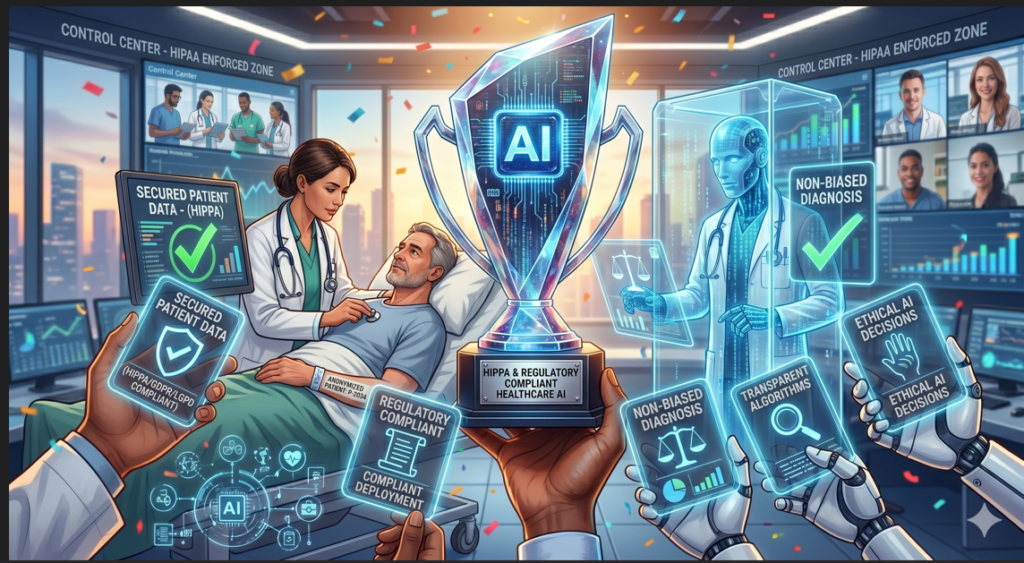
When implementing an AI chatbot, especially in enterprise or regulated environments, two major responsibilities are ensuring unbiased responses and keeping the chatbot continuously updated with the latest policies and organizational knowledge.
To ensure unbiased responses, I would approach the problem from multiple layers — data, model governance, testing, and human oversight.
First, I would ensure that the training and grounding data used by the chatbot is diverse, validated, and free from discriminatory or inappropriate content. Bias often originates from historical or imbalanced datasets, so I would work closely with domain experts, compliance teams, and AI engineers to review datasets and establish Responsible AI guidelines.
Second, I would establish AI governance mechanisms such as:
- Bias testing across demographic groups
- Toxicity and harmful content filtering
- Explainability and response traceability
- Human-in-the-loop review for sensitive use cases
- Escalation workflows where confidence scores are low
I would also define clear guardrails using prompt engineering, policy rules, moderation APIs, and role-based response restrictions to ensure the chatbot stays within approved boundaries.
Additionally, continuous monitoring is critical. I would implement feedback loops and analytics to track hallucinations, harmful responses, user complaints, sentiment, and drift in chatbot behavior. This allows the team to retrain or fine-tune the model proactively.
For ensuring the chatbot stays updated with new policies and organizational changes in a timely manner, I would avoid relying only on static model training. Instead, I would use a Retrieval-Augmented Generation (RAG) architecture where the chatbot retrieves responses from the latest approved enterprise knowledge base or policy repository in real time.
This approach provides several benefits:
- Faster policy updates without retraining the entire model
- Better accuracy and traceability
- Reduced hallucination risk
- Ability to cite source documents
I would also establish:
- A content governance workflow
- Version-controlled knowledge repositories
- Approval mechanisms for policy publication
- Automated synchronization pipelines between enterprise systems and the chatbot knowledge base
From a program management perspective, I would coordinate cross-functional teams including:
- AI/ML engineers
- Enterprise architects
- Compliance and legal teams
- HR or policy owners
- Security teams
- Business stakeholders
Using Agile practices, I would ensure periodic model evaluations, policy update sprints, UAT validations, and governance reviews to maintain both accuracy and compliance.
Ultimately, my goal would be to ensure the chatbot is not only intelligent and scalable, but also responsible, trustworthy, compliant, and aligned with organizational values.
A shorter executive version:
To ensure chatbot responses are unbiased, I would implement Responsible AI governance including diverse training data validation, bias testing, moderation controls, explainability, human oversight, and continuous monitoring for harmful or inaccurate outputs.
For keeping the chatbot updated with new policies, I would use a RAG-based architecture connected to approved enterprise knowledge sources instead of relying only on static model training. This enables real-time retrieval of the latest policy information with better accuracy and traceability.
From a program perspective, I would coordinate AI, compliance, security, and business teams through Agile governance, continuous testing, and controlled release management to ensure the chatbot remains accurate, compliant, and aligned with business objectives.
Important keywords to remember:
- Responsible AI
- Bias mitigation
- Hallucination control
- RAG (Retrieval-Augmented Generation)
- Human-in-the-loop
- Guardrails
- Prompt engineering
- Content moderation
- Knowledge base synchronization
- AI governance
- Drift monitoring
- Explainability
- Feedback loop
- Confidence scoring
