


You are working on a sensitive data where a machine learning model is to be created. How would you train the model without compromising data security and ensuring model training and performance is recorded
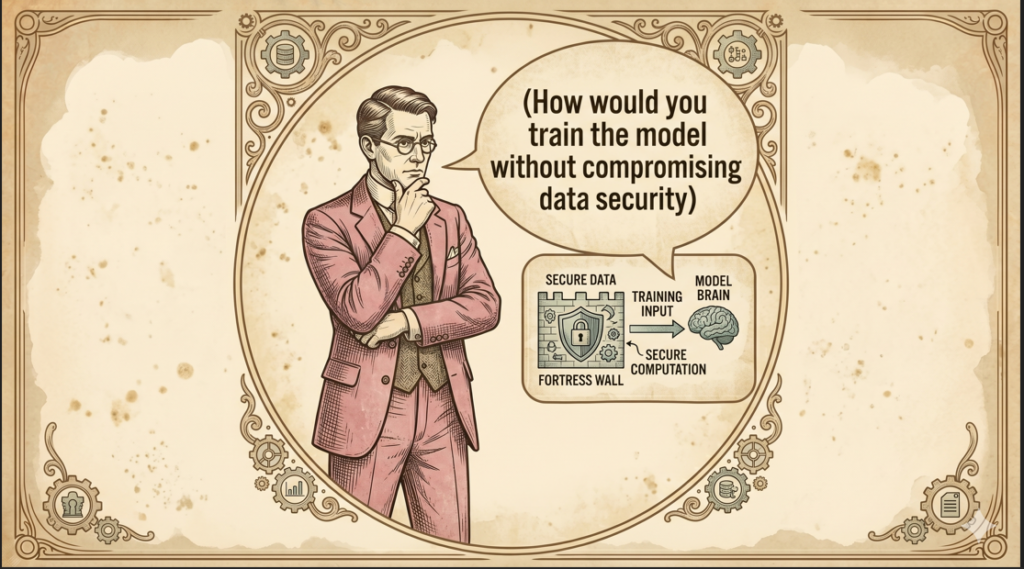
To train a machine learning model on sensitive data without compromising security, while also ensuring proper tracking of model training and performance, I would implement a combination of secure data governance, controlled ML operations (MLOps), and audit mechanisms throughout the AI lifecycle.
Here’s how I would approach it as an AI Program Manager:
1. Data Security & Governance
a. Data Classification
- Identify and classify data as:
- PII (Personally Identifiable Information)
- Financial data
- Healthcare/confidential data
- Internal business-sensitive data
- Apply security controls based on classification.
b. Data Minimization
- Use only the required fields for model training.
- Remove unnecessary sensitive attributes.
c. Data Anonymization / Masking
- Mask or tokenize sensitive fields such as:
- Aadhaar/PAN numbers
- Emails
- Phone numbers
- Account details
- Use pseudonymization techniques where traceability is needed.
d. Encryption
- Encrypt data:
- At rest using AES-256
- In transit using TLS/HTTPS
- Use secure key management systems.
e. Role-Based Access Control (RBAC)
- Restrict access using least-privilege principles.
- Developers should not directly access raw production data unless approved.
f. Secure Training Environment
- Use isolated environments/VPCs.
- Prevent public internet exposure.
- Enable monitoring and intrusion detection.
2. Secure Model Training Approach
a. Segregated Environments
Maintain separate:
- Development
- Testing
- Production
- Model training environments
b. Synthetic or Sample Data for Initial Development
- Use synthetic datasets during early experimentation.
- Move to real sensitive data only in controlled phases.
c. Federated Learning (if applicable)
For highly sensitive domains like banking or healthcare:
- Train models locally at data source locations.
- Share only model weights/gradients instead of raw data.
d. Differential Privacy
- Add controlled statistical noise to prevent leakage of individual records from trained models.
e. Data Leakage Prevention
- Ensure:
- Training data does not leak into testing datasets.
- No sensitive fields accidentally become prediction targets.
3. Model Training Tracking & Auditability
To ensure transparency and traceability, I would implement strong MLOps practices.
a. Experiment Tracking
Use tools like:
- MLflow
- Weights & Biases
- Kubeflow
Track:
- Dataset versions
- Hyperparameters
- Algorithms used
- Accuracy/F1 scores
- Training timestamps
- User who initiated training
b. Dataset Versioning
- Maintain versions of datasets used in every training cycle.
- Ensure reproducibility of results.
c. Model Registry
Store:
- Approved models
- Model metadata
- Security approvals
- Performance benchmarks
- Deployment history
d. Audit Logs
Capture:
- Who accessed data
- Who trained models
- What changes were made
- When deployment occurred
This helps during:
- Compliance audits
- Incident investigations
- Regulatory reviews
4. Performance Monitoring & Governance
a. Validation & Bias Checks
Before deployment:
- Validate accuracy
- Check bias/fairness
- Evaluate drift risks
- Conduct explainability analysis
b. Continuous Monitoring
Monitor:
- Model drift
- Prediction accuracy
- Data drift
- Security anomalies
c. Human-in-the-Loop Governance
For critical systems:
- Keep human approval for high-risk decisions.
- Example:
- Loan approval
- Medical diagnosis
- Fraud detection
5. Compliance & Regulatory Controls
Ensure alignment with:
- GDPR
- HIPAA
- ISO 27001
- SOC2
- Organization security policies
Also ensure:
- Consent management
- Data retention policies
- Right-to-delete compliance
For sensitive ML projects, one would establish a secure AI lifecycle by implementing data masking, encryption, RBAC access controls, and isolated training environments. One would use MLOps platforms like MLflow for experiment tracking and model registries to maintain auditability and reproducibility. Additionally, one would enforce governance through dataset versioning, monitoring, compliance checks, and continuous model performance tracking to ensure both security and operational transparency.”
